Forex basics 17 min read Updated 24 Oct 2026
What is forex? Learn the forex market from zero to your first trade
The world’s largest financial market from zero: its history, currency pairs, sessions in Tehran time, pips and lots, spreads, order types, candles, supply and demand, and the road every trader walks.
Forex is the largest financial market in the world: about $9.6 trillion changes hands there every day. Yet most people who come to it open their first trade before they know what a pip is, or how the ask price differs from the bid. This guide puts that order right: first understand the market, then step into it.
This article is based on the 28-page handout “A basic introduction to the forex market and trading in it”, which I translated and arranged for the Anadea community earlier, updated for 2026. If you are new, read it from the top; if not, use the table of contents to jump to the part you need.
In this article
- What is forex?
- The birth of modern forex: 1971 and the Nixon shock
- What does trading forex mean?
- Forex sessions in Tehran time
- Advantages of forex
- Disadvantages of forex
- Three main ways to trade forex
- How to read a currency pair
- Pips, ticks and points
- Bid, ask, spread and commission
- Margin, leverage and lots
- Order types in forex
- Reading Japanese candlesticks
- Supply and demand, and market structure: the basics
- The road to becoming a forex trader
- Summary
- Frequently asked questions about forex
What is forex?
Forex (or FX) is short for foreign exchange: the market where currencies are traded against each other. The euro against the dollar, the dollar against the Japanese yen, the pound against the Swiss franc, and hundreds of other pairs.
According to the latest Triennial Survey of the Bank for International Settlements (BIS), average daily forex trading reached $9.6 trillion in April 2025, and the US dollar was on one side of 89% of all trades. No other market in the world comes close.
Why do currencies have value?
A currency may have no intrinsic value, but it certainly has a use: a country’s money buys its goods and services. That is why currency is the most liquid asset there is. Every traveller who changes money at an airport, every company buying currency to import raw materials, every government moving its reserves, is using this same market.
The birth of modern forex: 1971 and the Nixon shock
Until 1971 the dollar was tied to gold. Under the Bretton Woods system, the United States promised to exchange dollars for gold, and other currencies were pegged to the dollar.
On 15 August 1971, President Richard Nixon announced that the US would no longer exchange dollars for gold. The dollar left the gold standard, and soon after the fixed-rate system was abandoned too; by 1973 the major currencies were floating. From then on, each currency’s value has been set only against other currencies. That is the birth of today’s forex market.
For those of us who trade gold, the date means something extra: from that day gold also became a floating asset against the dollar. The XAU/USD symbol we trade today came out of that change.
What does trading forex mean?
Two ways to make money
- Holding and swap: earning the interest-rate difference between two currencies. Mostly useful for long-term positions.
- Trading the swings: buying and selling a currency pair to profit from price going up and down. Most active traders, including us, work this way.
Pairs versus stocks: a two-way market
Stocks, indices and exchange-traded funds mostly rise over the long run, because they are meant to create value. Currency pairs are different: each currency’s value is relative to the other, so a pair can range for months or even years.
That makes forex a two-way market from the start. You can profit from price rising (a buy, or long, position) just as much as from it falling (a sell, or short, position). Shorting a pair simply means buying the second currency against the first.
Forex sessions in Tehran time
Forex is open 24 hours a day, 5 days a week, because currencies are traded all over the world. The trading day is split into “sessions”, each with its own volume and behaviour:
| Session | Summer (Tehran time) | Winter (Tehran time) | Character |
|---|---|---|---|
| Asia (Tokyo and Sydney) | about 01:30 to 11:30 | about the same | Lower volume; mostly ranging |
| London (Europe) | 11:30 to 20:30; Frankfurt open 10:30 | 12:30 to 21:30; Frankfurt open 11:30 | High volume; sets the day’s direction |
| New York | 16:30 to 01:30 | 17:30 to 02:30 | Overlaps London; the busiest hours |
On a normal day, price ranges in the Asian session, takes a first direction at the Frankfurt and London opens, and makes the day’s biggest move in the London–New York overlap. The time candles of the AATTOM style are built on exactly these hours; read more in time candles.
Advantages of forex
- Always open: wherever you are, at least one high-volume session is running.
- No need to search hundreds of stocks: most professional traders trade only 1 to 3 pairs or instruments. Fewer variables make it easier to learn the market’s behaviour and become consistent.
- Size and risk are simple to work out: position-size calculators and MetaTrader do it in seconds.
- Low spreads and huge liquidity: on the major pairs the gap between buy and sell prices is tiny and orders fill almost instantly.
- Funding from prop firms: companies that, after a test, let profitable traders trade their capital and keep part of the profit. (Before you sign up, read each firm’s rules on your country of residence.)
Disadvantages of forex
- A steeper learning curve: being able to buy and sell, sharp swings and high leverage make mistakes expensive. Forex demands discipline and risk management from the first trade.
- Price is heavily engineered: big players push price where they want by collecting small traders’ stops. If you don’t recognise this game, you are the money being collected; if you do, you can move with the big players.
- No real volume or market depth: forex is decentralised, and the volume your broker shows is only its own clients’ volume.
- Few platforms: most trading happens on MetaTrader 4 and 5 and cTrader. They look old and awkward at first, but you get used to them quickly.
Three main ways to trade forex
Classic retail methods
Trendlines, support and resistance, Fibonacci, classic patterns such as head and shoulders and double tops and bottoms, and indicators. They are the most common way into trading and there is nothing wrong with using them, but because everyone sees them, they are usually exactly where the stops pile up.
Fundamental analysis and news trading
Studying the macro economy, interest rates, inflation and political events. This needs serious economic knowledge and constant attention to the news, and it is harder for short-term trades.
Supply and demand, and smart money
Here, instead of generic signals, we look for the places where order flow changed: supply and demand zones, liquidity on both sides and market structure. It is harder to learn and usually has a lower win rate, but each trade’s reward-to-risk is larger. The AATTOM style is built on this base; to start, see the supply and demand articles.
How to read a currency pair
Every pair has two parts: the base currency, written first, and the quote currency, written second. The price tells you how many units of the quote currency one unit of the base currency costs.
If USD/CAD trades at 1.2600, one US dollar can be exchanged for 1.26 Canadian dollars. Buying USD/CAD means buying US dollars against Canadian dollars; selling it means the opposite. So if you want to buy Canadian dollars, you don’t need CAD/USD: just sell USD/CAD.
Major pairs
Pairs with the US dollar on one side and the highest volume. They have the lowest spreads and commissions and are the best choice for beginners:
| Pair | Base | Quote | Common name |
|---|---|---|---|
| EUR/USD | Euro | US dollar | Fiber |
| USD/JPY | US dollar | Japanese yen | Ninja |
| GBP/USD | British pound | US dollar | Cable |
| AUD/USD | Australian dollar | US dollar | Aussie |
| USD/CAD | US dollar | Canadian dollar | Loonie |
| USD/CHF | US dollar | Swiss franc | Swissie |
| NZD/USD | New Zealand dollar | US dollar | Kiwi |
Minor pairs
Pairs of large currencies without the US dollar, such as EUR/GBP, EUR/JPY, GBP/JPY and AUD/JPY. Lower volume and slightly wider spreads, but some traders prefer their cleaner moves; the yen pairs in the Asian session, for example.
Exotic pairs
Pairs with emerging-market currencies. Low volume, high spreads and commissions, irregular moves. Unless you have a specific reason, leave them alone.
Gold, indices and other instruments
Forex brokers don’t only offer currencies. Spot gold (XAU/USD) is one of the most traded instruments in the world: big swings, fair spreads and readable behaviour. Those swings also mean more risk, especially on low timeframes, so get to know gold in backtesting and on a demo account before you trade it for real.
Indices such as the Nasdaq (US100), the S&P 500 (US500), the Dow Jones (US30) and the DAX, big company shares as CFDs (contracts for difference), oil, silver and crypto are usually available in the same account.
Pips, ticks and points
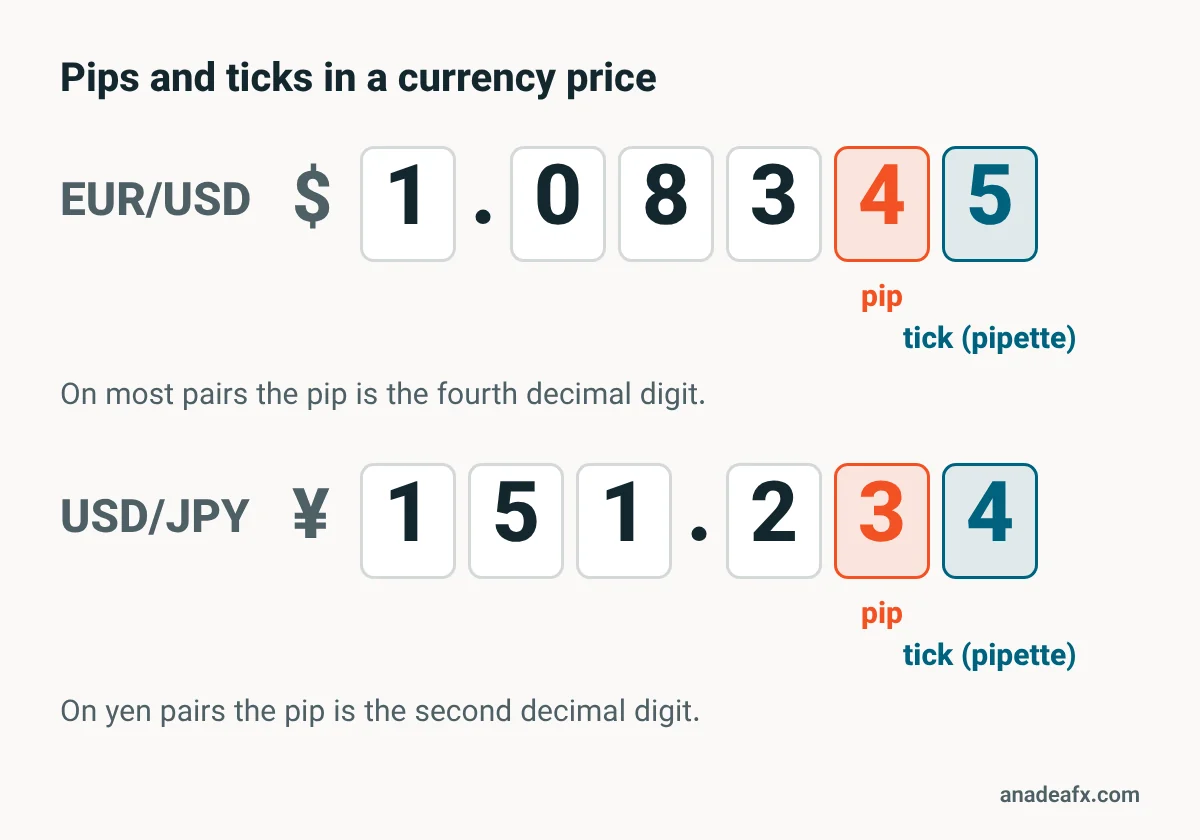
A pip is the unit of price movement. On most pairs, the pip is the fourth digit after the decimal point, and the fifth digit is called a tick or pipette (1 pip = 10 ticks). The one big exception is the yen pairs, which have two fewer decimals; their pip is the second digit after the point.
In gold the pip is not defined the same way by every broker; most count each $0.10 move as one pip. Always check the symbol specification at your own broker.
Bid, ask, spread and commission
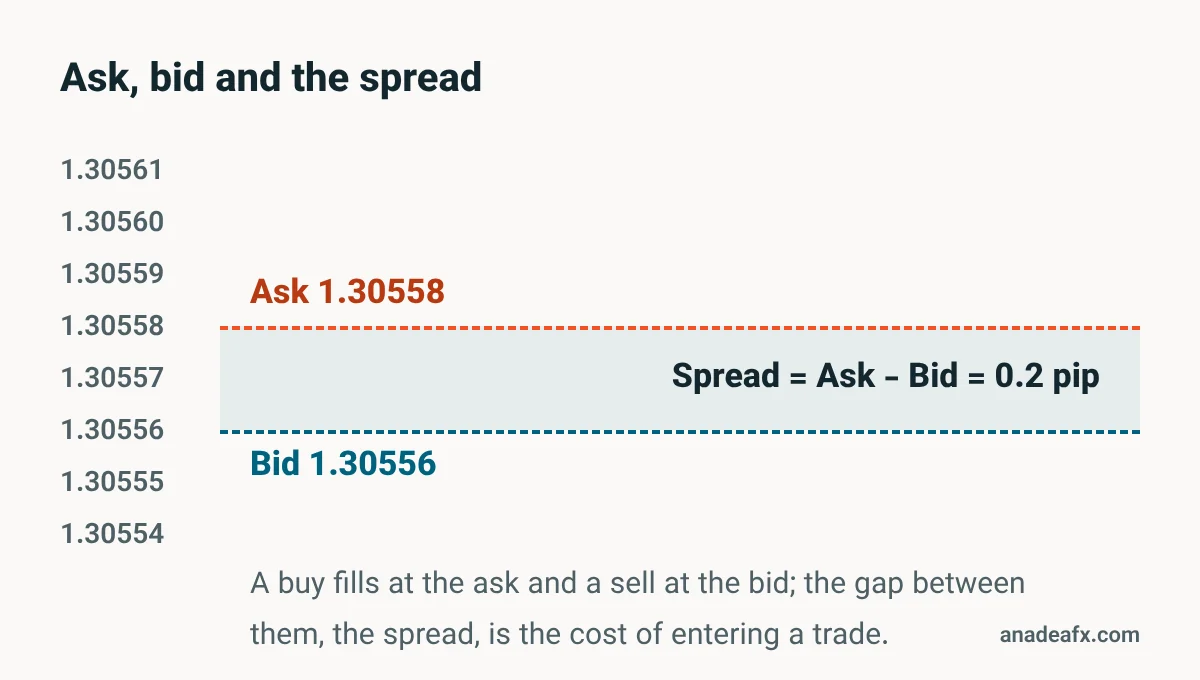
- Bid: the highest price buyers are willing to pay right now. When you sell, you are filled at this price.
- Ask: the lowest price sellers are willing to accept right now. When you buy, you are filled at this price.
- Spread: the gap between ask and bid; in effect, the cost of entering every trade. It depends on the instrument’s liquidity, the time of day and the broker, and it jumps at news releases and in thin hours (such as the start of the week).
Commission is a fee some accounts charge per lot. If a broker charges $5 per lot to open and $5 to close, the round-trip commission is $10 per lot. Before you open an account, check that the broker is regulated and that withdrawals work smoothly.
Margin, leverage and lots
Currency pairs usually move less than one percent in a day. To make such small moves worth trading, your broker gives you leverage: with 1:100 you can open a position a hundred times your deposit. That deposit is called margin. Leverage is a double-edged sword: it magnifies profits and losses alike.
A lot is the unit of trade size, and it is tied directly to your risk. Without the right size, one trade can wipe out the account. For pairs quoted in US dollars, each pip is worth:
| Lot type | Size (lots) | Units | Value per pip |
|---|---|---|---|
| Standard | 1 | 100,000 | $10 |
| Mini | 0.1 | 10,000 | $1 |
| Micro | 0.01 | 1,000 | $0.10 |
| Nano | 0.001 | 100 | $0.01 |
Always size from risk, never the other way round: first decide the most you will risk on this trade (0.25 to 1 percent of the account for most traders), then work out the lot size from the stop distance.
Order types in forex
MetaTrader has about 8 kinds of order:
- Market buy / sell: enter immediately at the current price.
- Buy limit / sell limit: enter when price comes back to a set level.
- Buy stop / sell stop: enter after price passes a level.
- Stop loss: exit automatically if the trade goes against you.
- Take profit: exit automatically at the profit level.
Market orders
The fastest way in; experienced traders use them for precise timing. The drawback is that the order fills at the exact moment you press the button; if price has moved away from your level in that moment, you get a worse price.
Limit orders
The best order type for beginners: you set the level in advance, and nothing opens until price gets there. The one exception is fast, thin moments such as major news, when the order may fill worse with slippage.
Stop orders
The breakout trader’s favourite tool. In forex, price often breaks obvious levels, collects the liquidity behind them and comes back; that is why in the supply and demand style we rarely use this order.
The stop loss: the most important order
Setting a stop loss on every trade is the most important thing a trader does. In our style there is no scenario without a stop loss. You may move the stop toward profit to cut risk, but never move it further from your entry. The rule sounds simple, but most beginners break it.
Take profit: four ways out
- Close the whole position by hand.
- A fixed take profit that closes the whole position.
- Close part of the position by hand.
- Stepped take profits that close part of the position at each level.
Long and short positions, and measuring profit in R
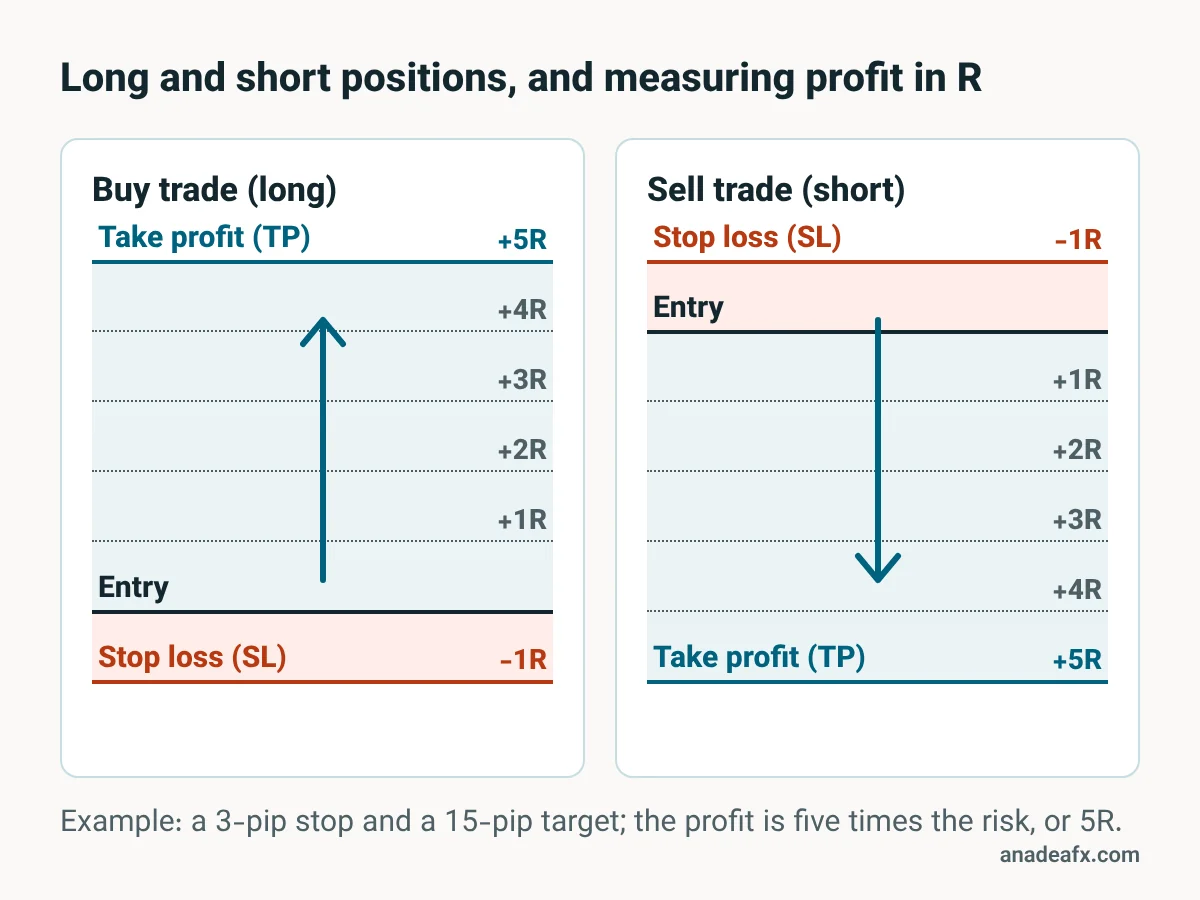
In our style we measure profit and loss in R: R is the amount you risked on the trade. With a 3-pip stop and a 15-pip target, the profit is five times the risk: 5R. If the stop is hit, the result is minus 1R. A short position mirrors a long one: the stop above the entry, the target below it.
Reading Japanese candlesticks
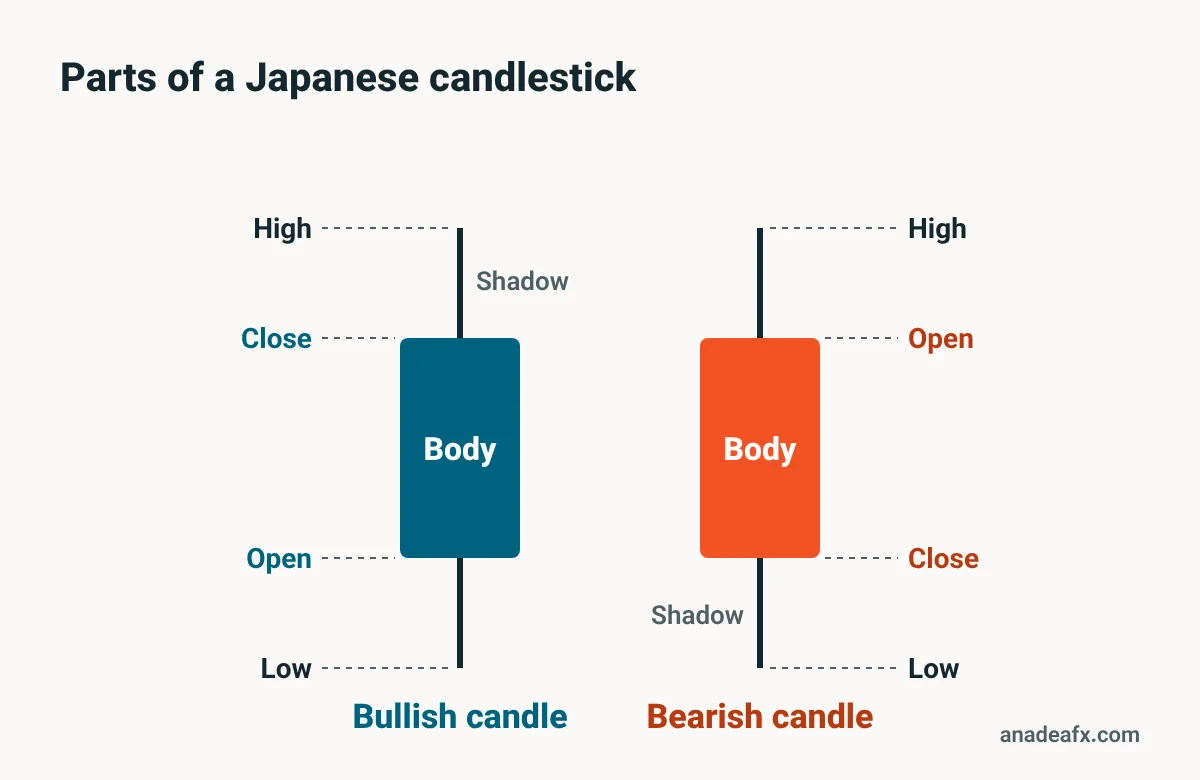
After the basics, the first core skill is reading a candlestick chart. A line chart shows only closing prices, but each candle tells four numbers at a glance: the open, the close, and the highest and lowest prices of that period. The body runs from open to close; the shadows (wicks) reach the high and the low.
Each candle sums up a small story. Once you learn what candles say in sequence, you can read buyers’ and sellers’ behaviour behind the chart. In the AATTOM style, 1-minute candles that form at set Tehran hours play a key role.
Supply and demand, and market structure: the basics
Once you know candles, the next step is finding supply and demand zones: areas price left with force, where unfilled orders remain. Price usually comes back to these areas and reacts.
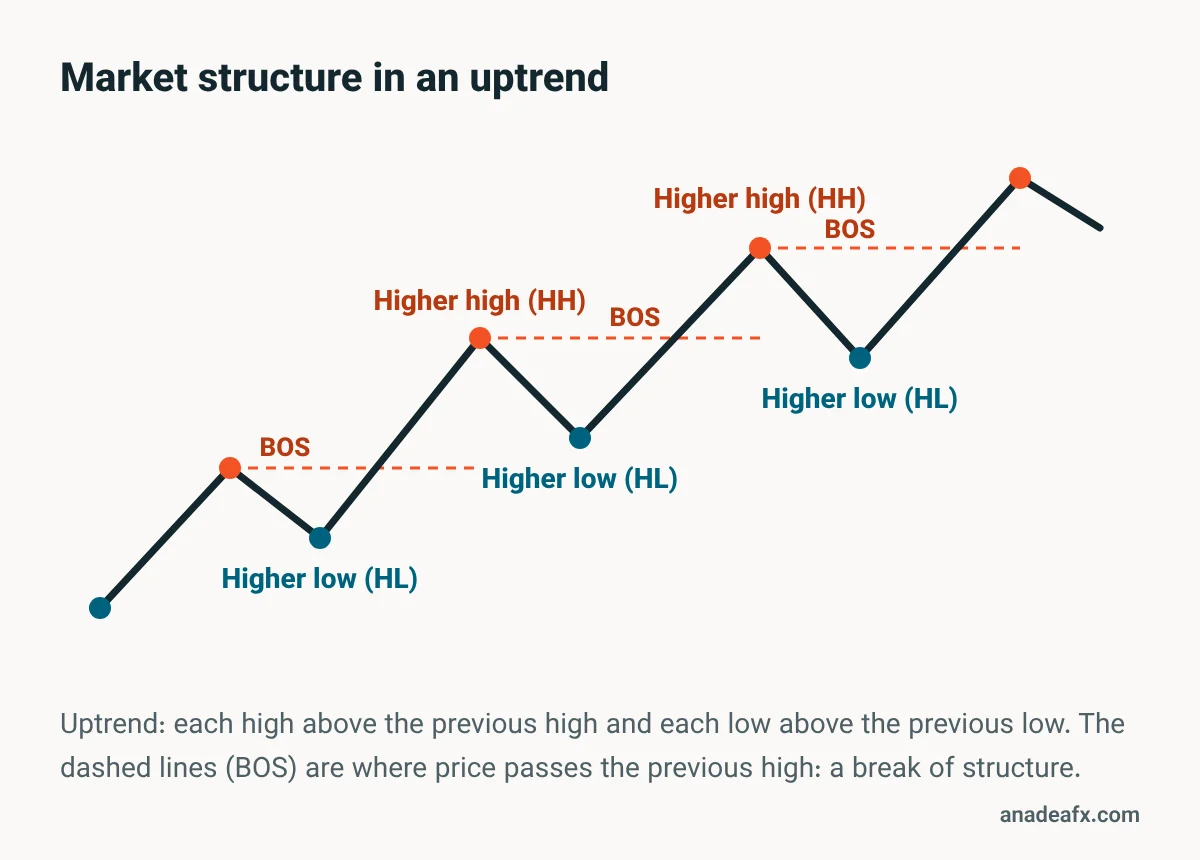
Market structure shows whether the trend on each timeframe is up or down. In an uptrend, each high is above the previous high (HH) and each low above the previous low (HL); price passing a previous high is a break of structure (BOS). Trading against the trend is not forbidden, but it means swimming against the market’s flow, with lower odds. For more, see the liquidity and structure articles.
Multi-timeframe analysis
Before every trade, start the analysis from the top: weekly, daily, 4-hour and 15-minute, and for day trades, the 1-minute chart last. Without the big picture, an entry on a low timeframe is only a guess.
News events
Major economic news (US interest rates, inflation and jobs) causes sharp swings. You don’t need to be a news analyst, but you must know what is released today and at what time. At the release, liquidity is thin and price jumps; a stop can fill with far more slippage than planned. That is why many prop firms ban trading around major news.
The road to becoming a forex trader
Start small
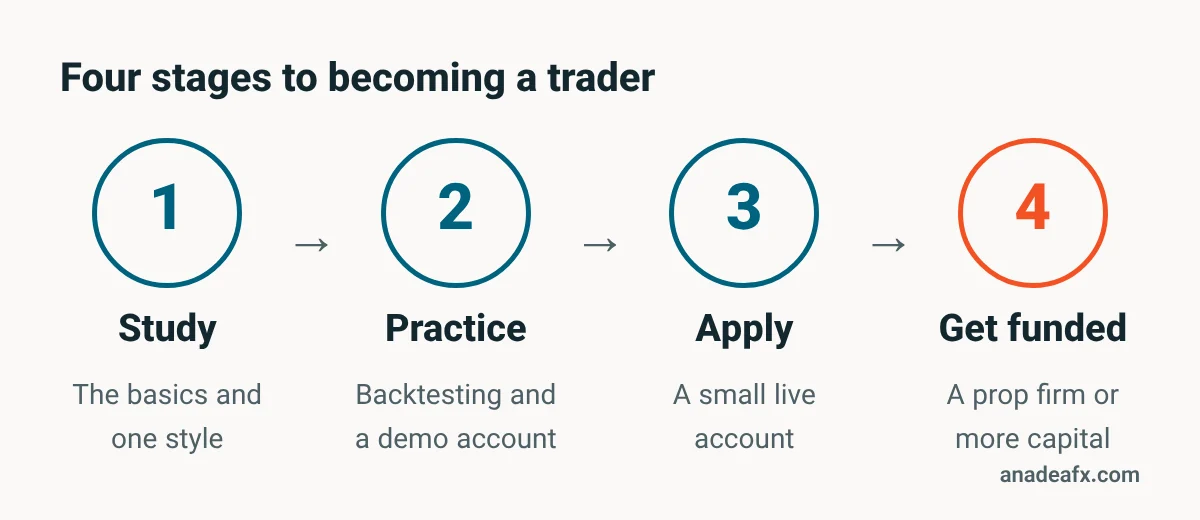
Confidence comes from work and results, so start with small goals and grow them. If you are completely new, start with a demo account or a very small live account: an amount you won’t mind losing. If risking $50 a trade takes you out of your comfort zone, don’t start with a $5,000 account at 1% risk.
You won’t get rich overnight
Trading is not a fast route to wealth, however many crypto and trading success stories you hear. Like any business, it has no shortcut; only hard work pays. If you are ready to walk a one-, two-, three- or even five-year road seriously, you have a chance. If you think you’ll be a millionaire in 30 days, this road is not for you.
Expect losses
At the start you will have about as many losing trades as winners. A 50% win rate or higher, even with the simplest methods, is excellent. We also look for methods whose wins are several times their losses, not a method that never loses. Value the valid losses that followed your plan.
Success depends on how you handle failure
Failure is our best teacher. Just as a boxer learns to take a punch before throwing one, a trader first learns to tolerate a loss. Fear, hesitation and overtrading are normal stages of learning. The important question is: in daily life, are you too hard on yourself? Do you make decisions on impulse? Do you get bored quickly? These need fixing in yourself before the market.
Expect your biggest disappointment
Sometimes a few wins in a row make you overconfident, and one big loss takes it all back. You try again, and the cycle repeats a few times, until you find your mistakes and consistency comes. If after several cycles the same mistakes keep coming back, look at yourself honestly.
Family and friends may not support you
For many of us this is one of the hardest parts. Don’t let other people’s opinions into your trades. And one serious piece of advice: 9 out of every 10 people who come to trading are better off keeping their job or main income while they learn. Anyone who forces trading to pay the bills almost always loses.
Not everyone succeeds at trading
Not everyone can become an astronaut or a physicist, and not everyone becomes a profitable trader. Professional trading is unforgiving and, without risk management, can wreck a life. The right way is patience, practice and experience: backtesting, demo, and live trading with a small account. Reading ten books about cycling doesn’t make anyone a cyclist.
Find a strategy and build consistency
There are thousands of profitable ways to trade: price action, indicators, trading bots, supply and demand. Whichever you choose, you must run it without straying from your trading plan and with proper risk management. Consistency, like in any profession, takes time and practice, and everyone learns at a different speed. If one day you reach steady profitability, you will be one of the few who walked this winding road with patience.
Summary
Forex is the largest and most liquid market in the world: open 24 hours, two-way and full of opportunity, but with high leverage and heavy price engineering. Before your first trade, know these: pairs and sessions, pips, lots and spreads, order types and the stop loss, candles and market structure, and above all, that losses are part of the job.
Next steps:
- Watch the free Anadea course from the start; you learn the AATTOM style from the ground up (in Persian).
- Follow the free Telegram channel; the weekly gold analysis goes out there every Monday.
- For the daily analysis, the New York session update and the full style videos, see the AATTOM Community.
- Take risk management and psychology seriously: psychology and routine articles.
Frequently asked questions about forex
What is forex?
Forex, or the foreign exchange market, is where currencies are traded against each other. With an average of $9.6 trillion traded a day, it is the largest financial market in the world, open 24 hours a day, 5 days a week.
What is a pip in forex?
A pip is the unit of price movement. On most pairs it is the fourth decimal digit; on yen pairs, the second. The digit after the pip is called a tick or pipette.
How big is a lot in forex?
A standard lot is 100,000 units of the base currency. On pairs quoted in US dollars, each pip is worth about $10 for a standard lot, $1 for a mini lot (0.1) and 10 cents for a micro lot (0.01).
What is the spread?
The spread is the gap between the ask and the bid, and in practice it is the cost of entering each trade. It is small on the major pairs and widens at news releases and in thin hours.
What is the best time to trade forex in Tehran time?
The busiest hours are the London–New York overlap: about 16:30 to 20:30 Tehran time in the European and US summer, and about 17:30 to 21:30 in winter. The Frankfurt and London opens usually set the day’s first direction.
How much money do I need to start forex?
There is no fixed number. Our advice: practise on a demo account first, then start with a small live account you won’t mind losing, and risk only 0.25 to 1 percent of the account per trade.
How long does it take to learn forex?
A few weeks are enough for the basics, but reaching consistency usually takes months to years of practice. Research suggests forming a new habit takes 66 days on average; a trading routine is no exception.
This article is education, not financial advice or a signal. Trading forex and gold is high risk, and you may lose much or all of your money.
Related lessons
Forex basics
Prop firms for Iranians in 2026: which accept Iranians, and what to check before buying a challenge
Do FTMO, The5ers and FundedNext accept residents of Iran? What are the risks of Iranian prop firms? How prop firms really pay, the rules that burn challenges, and a 10-step checklist before you buy.
Forex basics
Brokers for Iranians in 2026: which brokers work, and what to check before you deposit
Alpari, AMarkets, Errante and Opofinance reviewed from their own documents, what the Nobitex, Wallex and Tether sanctions mean for deposits, and a 10-step checklist for choosing a broker in 2026.