Forex basics 6 min read Updated 24 Oct 2026
Prop firms for Iranians in 2026: which accept Iranians, and what to check before buying a challenge
Do FTMO, The5ers and FundedNext accept residents of Iran? What are the risks of Iranian prop firms? How prop firms really pay, the rules that burn challenges, and a 10-step checklist before you buy.
For many of us, a prop firm is the only way to trade large capital: you pay a few tens of dollars for a challenge, and if you pass, you trade a $50,000 or $100,000 account and withdraw part of the profit. But for residents of Iran, two questions come before anything else: does this prop firm accept Iranians at all? And if I make a profit, will it actually pay? This article answers both from the firms’ own rules and independent sources, as of October 2026.
Reviewed: 16 October 2026. Prop firm rules change constantly; before buying any challenge, read the rules again on the firm’s own site. This article is education, not an advertisement for any prop firm; Anadea has no partnership or affiliate link with any prop firm.
In this article
How does a prop firm really work?
Before choosing, you should know where the money you are paid comes from. At almost every prop firm today:
- Your account is simulated. Trades run on a server with real market prices, but the $100,000 balance is virtual and your orders don’t go to the real market.
- The firm pays profits from its own income. The main source of that income is the challenge fees, which most buyers fail (PropFirmsFinder).
- Your risk is limited; the firm’s is not. You lose at most the challenge fee, but if the firm shuts down, profit you haven’t withdrawn is usually gone, and there is no insurance or compensation fund.
The model is fragile. Since 2024, dozens of prop firms have closed, many after MetaQuotes restricted prop firms’ MetaTrader licences or when they couldn’t pay out profits. In January 2026, FundingTicks also shut down after protests over a sudden change to its rules (The Prop Firm Guide).
Do the well-known international prop firms accept Iranians?
In short: most don’t. This table comes from the firms’ own rules and prop-comparison sites in October 2026:
| Prop firm | Residents of Iran | Note |
|---|---|---|
| FTMO | No | Residents of Iran are rejected; Iranian citizens only if resident in the EEA with a European bank account. |
| The5ers | No | Iran is on the restricted list in its FAQ. |
| FundedNext | Unclear | The official page text doesn’t name Iran, but the full list is shown as an image, and Persian comparison sites don’t consider it open to Iran. |
| E8, Topstep, Apex and FundedNext Futures | No | They state explicitly that they don’t accept traders from Iran. |
Important: these firms run full identity verification (KYC) at the first payout. Signing up with another country’s address or documents might get you through the challenge, but exactly when you have made a profit, verification fails and the profit is voided. Never take that risk.
Iranian prop firms: what they are and what the risks are
What most Iranians actually use are prop firms run by Iranian teams, with the company usually registered in St Lucia or Dubai. They accept residents of Iran, have Persian sites and support, and pay profits in Tether and sometimes in rials. The names that appear most in Persian lists: Sarmayeh Gozar Bartar (SGB), FeneFX, Propco, Arya Investor, Traders Combat, Robinsood and LastProp.
We have not verified any of them individually, and their names here are not a recommendation. The risks they share:
- No regulator supervises prop firms. Iranian or foreign. Trust is built only from a real payout record.
- Payouts depend on challenge sales. A smaller, newer firm means a shorter payout record and more risk.
- Iran’s internet shutdowns. In nationwide shutdowns, access to the dashboard and platform is cut, and some firms’ services came back only step by step. Read the inactivity and open-position rules before you buy.
- Persian “best prop firm” lists are not neutral. Some are published by a prop firm that puts itself first; others earn a commission on every purchase.
The rules that burn most challenges
Most accounts don’t burn on one big loss; they burn on a rule nobody read. Find these exactly before you buy:
- Daily loss limit: is it based on the day’s starting balance or on live equity? Do open losing positions count? When does the day start in Tehran time?
- Maximum loss: fixed, or trailing as the account grows?
- Consistency rule: can one very profitable day void a payout?
- Trading around news: is it banned? For how many minutes before and after?
- Holding over the weekend and minimum trading days.
- Expert advisors, copy trading and hedging between accounts.
- Inactivity rule: if you can’t trade for a few days because of an internet shutdown, does the account burn?
A 10-step checklist before you buy a challenge
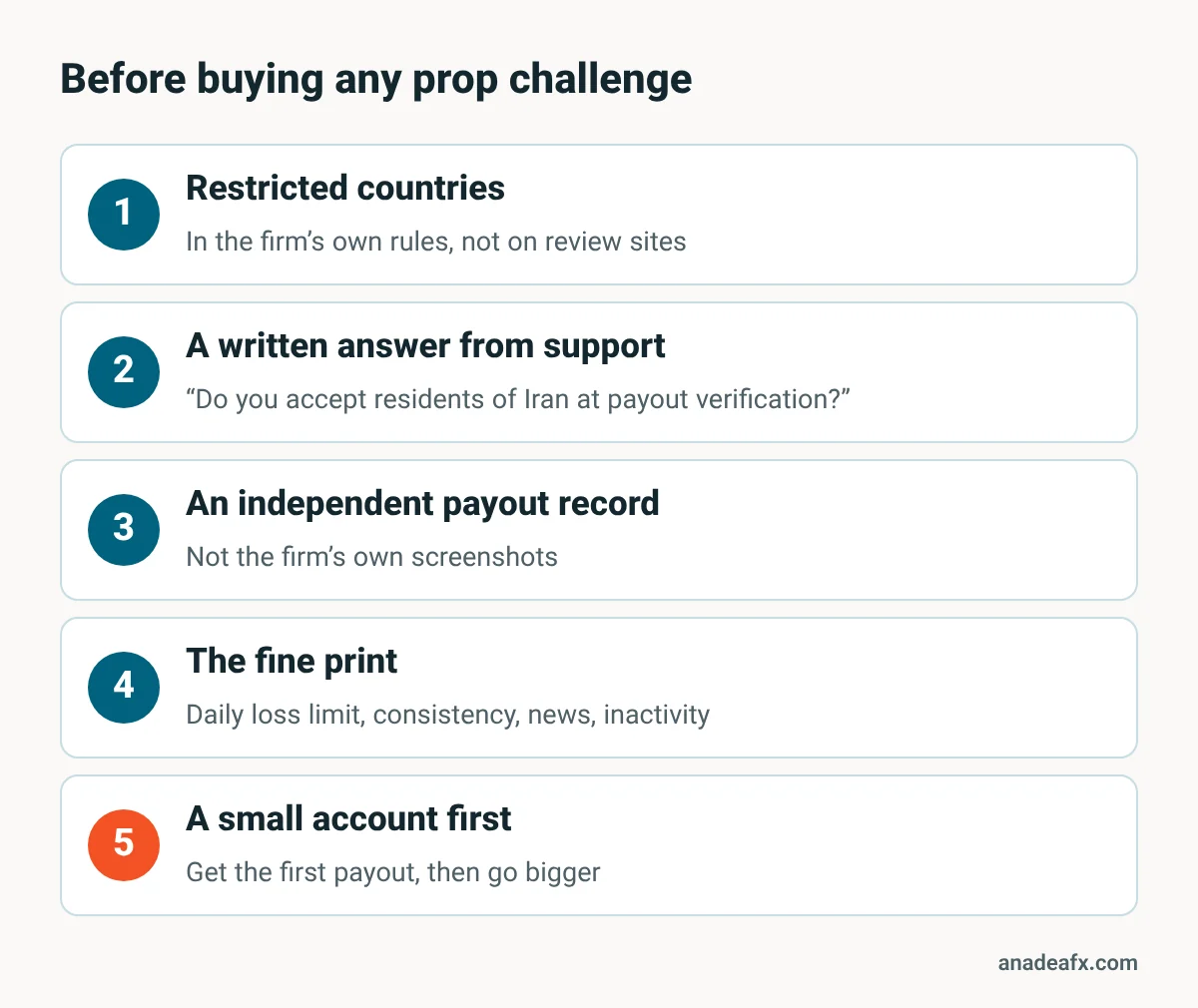
- Find the restricted countries in the firm’s own rules, not on review sites.
- If the firm is international, ask before buying, in writing: “Do you accept residents of Iran with Iranian documents at payout verification?”
- Find the registered company and its country; a firm with no clear legal identity is a red line.
- Check the payout record from independent sources, not the firm’s own screenshots; screenshots are easy to fake.
- Know the payout method and timing (Tether, network, rials, minimum amount, how often).
- Read all the rules above, especially the daily loss limit and the consistency rule.
- If a firm changes its rules suddenly or rebrands, stay away.
- Look at very cheap challenges and permanent 80% discounts with caution; a prop firm lives on selling challenges.
- Start with the smallest account and get your first payout, then move to a bigger account.
- Withdraw profits regularly. Profit left in a prop account isn’t yours until it is withdrawn.
Frequently asked questions about prop firms for Iranians
Does FTMO accept Iranians?
Not residents of Iran. Under FTMO’s rules, an Iranian citizen is accepted only if resident in a European Economic Area country with a bank account in their own name at a European bank.
Is an Iranian prop firm better than a foreign one?
For residents of Iran, most well-known foreign prop firms are effectively out of reach. Iranian prop firms accept Iranians and pay in Tether, but nobody supervises them; their payout record and the clarity of their rules are your only measure.
Is prop firm money real?
At almost every prop firm your account is simulated, and the firm pays profit from its own income. So your payout depends on that firm’s financial health.
Can I sign up for a foreign prop firm with another country’s documents?
Not if you don’t actually live there. Payout verification finds it and the profit is voided; you lose the challenge fee and months of work.
How much does a prop challenge cost?
From about $15 to several hundred dollars, depending on the account size and the firm. The cheapest challenge isn’t necessarily the best; the rules and the payout record matter more than the price.
Where should I start to pass a prop challenge?
Risk management first: in challenges with a 4 to 5% daily loss limit, the risk per trade must be small. See the psychology and routine and what is forex articles, and settle your style on a demo account first.
This article is education, not financial advice or an advertisement for any prop firm. Anadea has no partnership or affiliate link with any prop firm. Trading forex and gold is high risk.
Related lessons
Forex basics
Brokers for Iranians in 2026: which brokers work, and what to check before you deposit
Alpari, AMarkets, Errante and Opofinance reviewed from their own documents, what the Nobitex, Wallex and Tether sanctions mean for deposits, and a 10-step checklist for choosing a broker in 2026.

Forex basics
What is forex? Learn the forex market from zero to your first trade
The world’s largest financial market from zero: its history, currency pairs, sessions in Tehran time, pips and lots, spreads, order types, candles, supply and demand, and the road every trader walks.